Off-the-shelf CRM or build your own: choosing without regretting it in a year
You have five people in sales and five separate spreadsheets. Who called whom, which enquiry is stuck and why — only the person who owns that file knows, and when they go on holiday, nobody does. At some point you decide you need a system.
Then you hear two answers. One: take an off-the-shelf CRM, you will be running next week. The other: your process is unusual, you need something built for you. Both sound reasonable. The trouble is that the wrong choice does not announce itself — it shows up a year later, once reversing it is no longer cheap.
Start with the honest answer
For most companies asking this question, the right answer is an off-the-shelf CRM.
We write that as a studio that also builds custom systems, and it argues against our own interest: a bespoke build is a bigger budget and a longer engagement. Even so, a supplier whose default reply is "your process is unique, let's build from scratch" is usually selling their project rather than solving your problem. Worth knowing going in.
The sense of being unusual is usually misleading. From the inside your process looks specific, because it grew that way over years. From the outside, the same skeleton repeats across thousands of companies: an enquiry arrives, gets qualified, a proposal goes out, a negotiation happens, the deal closes or is lost. An off-the-shelf CRM already knows that skeleton and does not need to rediscover it for you.
What off-the-shelf genuinely gives you
The value of a ready-made platform is not the feature list. It is the work it takes off your desk:
- It works next week, not in six months. Six months of waiting is six more months of living in spreadsheets, with the habits setting harder.
- Somebody else runs it. Upgrades, security patches, backups, staying online. On your own system all of that is yours, and it never ends.
- The integrations already exist. Mail, calendar, telephony, messaging channels, accounting — written and hardened before you needed them.
- Being wrong is comparatively cheap. If it does not fit after three months, you lose the subscription and the effort of moving. With a system written from scratch, what you lose is the whole build.
Those are real advantages and it would be dishonest to talk them down.
Where its real cost hides
The invoice is visible from day one. The actual cost arrives later, in three forms.
Per-seat pricing scales with headcount. A number that looks trivial across five people reads very differently across forty. And the capability you eventually need is usually one tier up — so at the exact moment you grow, both the seat count and the rate move together.
You did not choose the data model. Your business may have an object their model simply does not have: a customer with several branches, an order with several delivery stages, a long-term contract with recurring monthly work. You force these into the fields that exist, and then the reports stop telling the truth — not because the reporting is bad, but because the data sits in the wrong shape.
Export friction is real. Almost every platform has an export button. What comes out is usually a pile of CSVs: the records leave, while the relationships, the history, the attachments and the automation logic stay behind. Your data is formally yours; in working form it is still theirs.
The real cost of an off-the-shelf system is not the licence. It is the time you spend bending your process to fit someone else's model. Sometimes that bending is healthy and forces overdue discipline. Sometimes it flattens the one thing you do better than your competitors. You want to know which before you buy.
When a custom build is genuinely cheaper
Over a three-year window, building your own really is the better economics in some cases. They are specific, and they are the minority.
When it is true
If your process is your product — routing in logistics, a laboratory workflow, a tour operator with its own pricing rules, batch tracking in manufacturing — then compressing it into a generic model makes you interchangeable with your competitors. Here the custom build is not an expense; it is the advantage itself. In those cases the work usually becomes web app development.
If you have many users who each need very little, per-seat economics work against you: a full licence for each of fifty warehouse staff who open the system three times a day makes no sense.
If a shadow system has already grown on top of the tool — fourteen spreadsheets, automations wiring them together, and a group chat holding it upright — that is the most honest signal you have that the fit is wrong. Maintaining that shadow costs real money and time; it just never arrives as an invoice.
And if a contract or a regulator requires the data to stay under your control, the choice narrows on its own.
When the argument is flattering you
"Our process is unique" very often means "our process is undocumented". An undocumented process is not unusual — it is invisible. Move it into a system written from scratch and you have encoded the mess, and changing it afterwards costs more, not less.
The second trap is the promise that a custom system will be exactly what you want. It will be — on day one. Then the business changes and the system does not, because every change needs a budget and a place in a queue. On an off-the-shelf platform, many of those changes are something your own team can make.
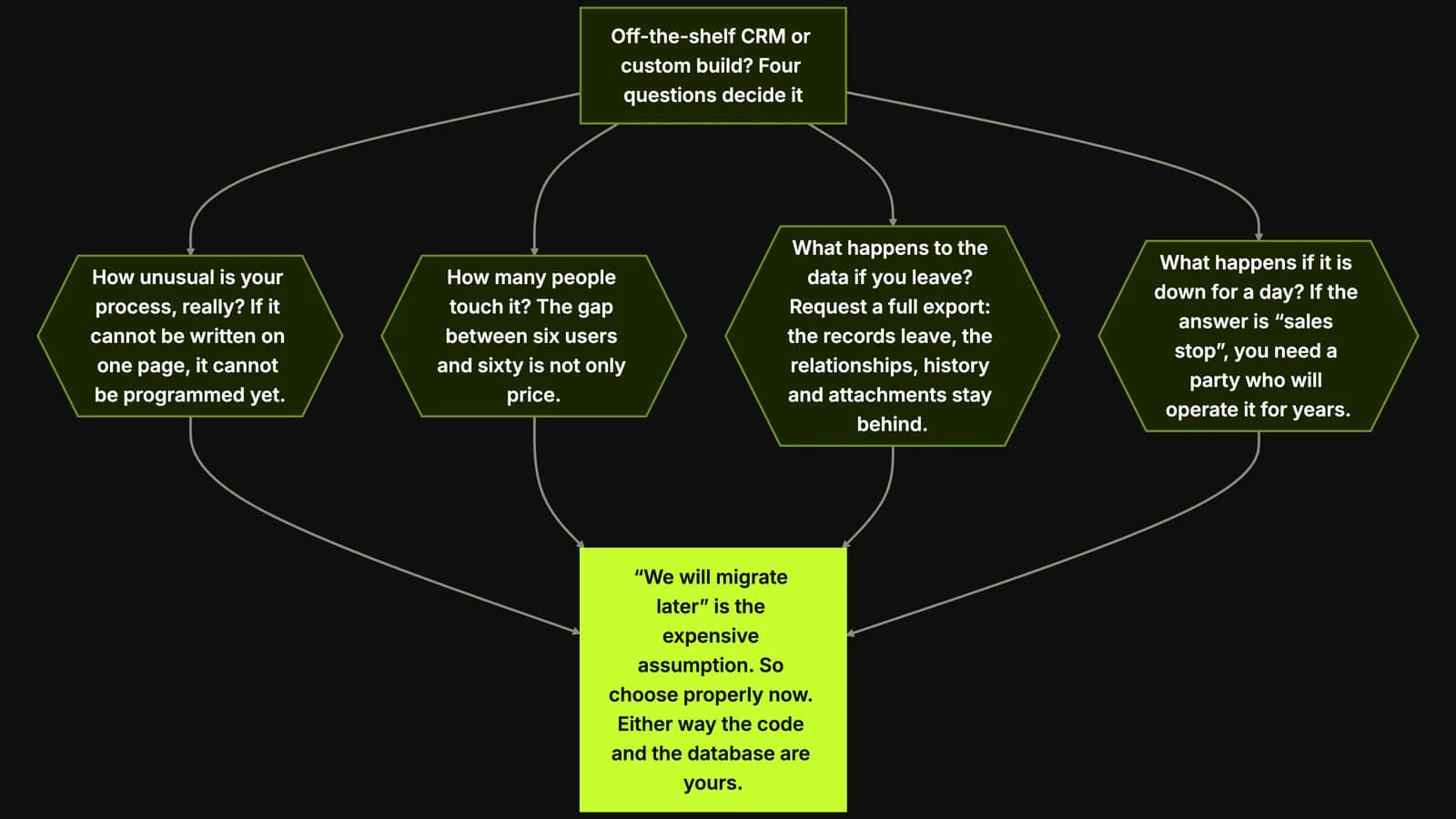
The four questions that decide your CRM choice
Answer these honestly and the conclusion tends to present itself.
- How unusual is your process, really? The test is simple: write it on one page. If it cannot be written down, it cannot be programmed yet. Fix the process first, then choose the system.
- How many people touch it? The gap between six users and sixty is not only price: training, permissions, cleaning bad data and support load all scale with headcount, and an off-the-shelf platform has already solved those.
- What happens to the data if you leave? Reading the contract clause is not enough. Request a full export today and open the file — check whether relationships, history and attachments are in it. You want that answer before the purchase.
- What happens if it is down for a day? If the answer is "sales stop", you need a party who will operate it for years, not one who will build it once. That is an organisational question, not a technical one.
"We will migrate later" is the expensive assumption
The most common sentence in this decision is: start cheap, move when we outgrow it. It understates the cost of moving, reliably.
The hard part is not the records. It is two years of habits, the automations and reports and forms accumulated inside the tool, and the fact that the old data model does not map cleanly onto the new one. Migrations also land at the worst possible moment — precisely when you are growing and the team is already stretched.
So choose properly now. But hedge either way:
- Keep the data under your own control from day one: a regular, complete export you can actually read, stored somewhere you know.
- Be able to say in one sentence where the master copy of a customer record lives. If there is no answer, the problem is organisational, not technical.
- Do not tie critical integrations entirely to a platform's internal logic — document the key flows separately from the tool that runs them.
The practical answer: a bought core, a built edge
For most companies the healthy option sits in the middle: an off-the-shelf CRM as the core, with the edges built around you. Site forms land in the system directly, calls, WhatsApp and Instagram converge on one customer record, and reporting is assembled in a warehouse you own — so an independent copy of the data always stays with you. Pulling the site, calls and messaging into one customer record is what we call CRM integration.
That is how we approach it. If a ready-made platform fits, we say so and build the integrations on top of it. If a custom build is warranted, we name the specific reason. Either way the code and the database are yours. More detail: CRM, ERP and business systems.
Avoiding regret a year from now is not a matter of buying a more expensive system. It is writing the process down before you choose, knowing who holds the data, and refusing to leave that question for later.
Photos provided by Pexels